Concept | What & why?
Overarching mental models, paradigms, or principles. They provide long-term orientation.
E.g.: Domain-Driven Design, Microservices, Agile Mindset
Nexonoma is not a loose collection of terms, but a systemic network. Three types of building blocks interlock to make knowledge not just stored, but navigable and decision-oriented.
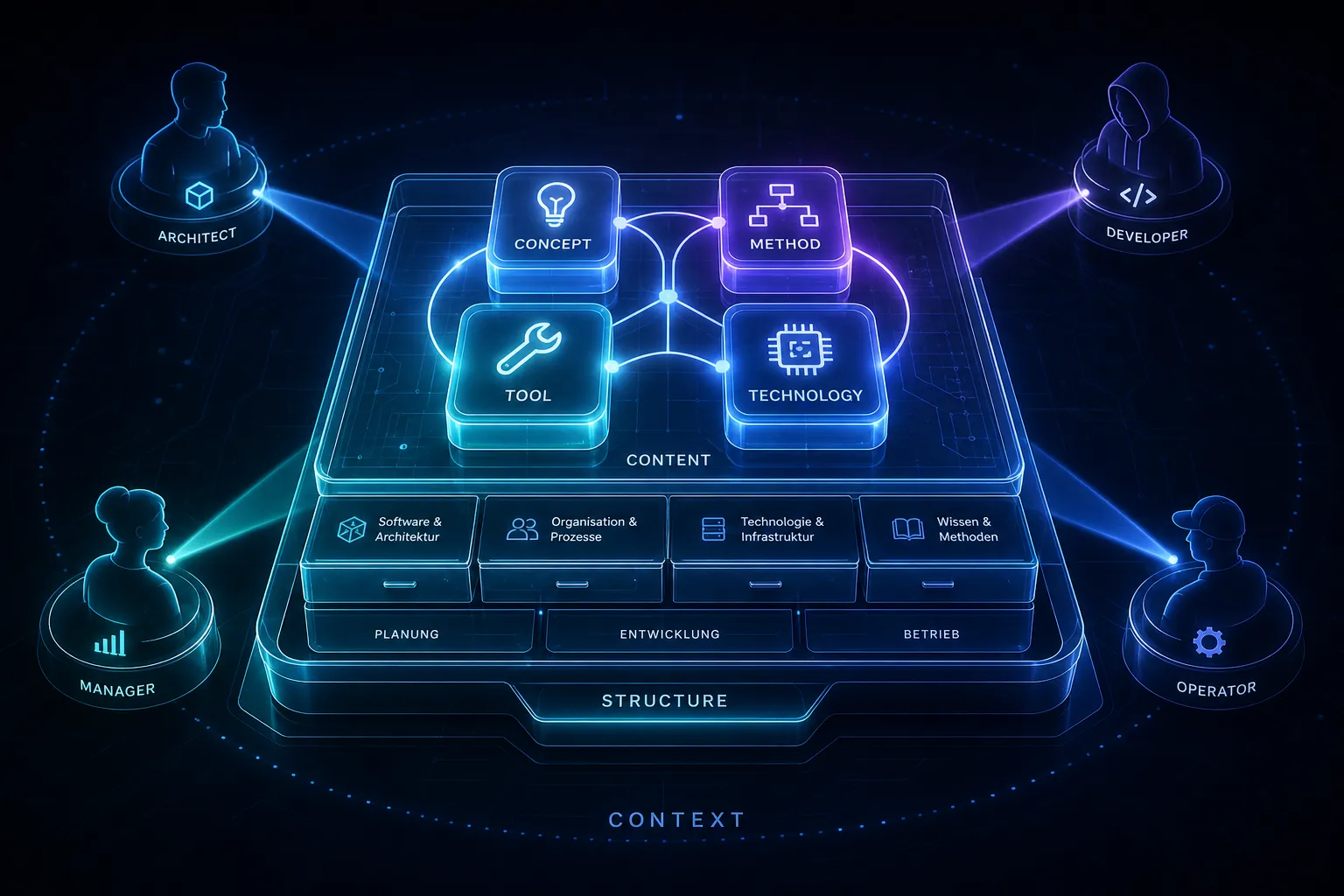
The model shows: Knowledge (center) lives in thematic spaces (structure). Perspective (outer ring) determines which path leads to knowledge.
The knowledge
The actual content. It describes concepts, methods, tools, and technologies. Definitions and facts live here.
The order
The thematic spaces. They create the coordinate system (clusters & segments) in which knowledge is placed.
The perspective
The filter. Roles define what is relevant for whom and enable personalized views of the overall model.
Nexonoma distinguishes four fundamental knowledge types to create clarity. Each type answers a different core question. The guide to feedback loops in System Thinking for Architects goes deeper into feedback loops and perspectives.
Overarching mental models, paradigms, or principles. They provide long-term orientation.
E.g.: Domain-Driven Design, Microservices, Agile Mindset
Concrete approaches or structured processes. They are action-oriented and produce results.
E.g.: Event Storming, Scrum Sprint, Business Model Canvas
Tools for implementation. Usually software that supports analysis, planning, or operations.
E.g.: Miro, Structurizr, Jira, Terraform
Technical foundation or platform. It forms the basis for tools and applications.
E.g.: Kubernetes, Kafka, React, Python
Without structure, knowledge is chaotic. Structure building blocks define the “spaces” where knowledge is stored. They enable the creation of maps (city views).
Thematic macro areas (“districts of the city”).
e.g. Software & Architecture, Organization & Strategy.
Refinements (“paths & phases”).
e.g. Planning, Operations, Delivery.
By separating content (what) from structure (where), we can later show the same content in different contexts.
A tool like “Terraform” clearly belongs to the cluster “Technology,” but can be relevant in the segment “Development” AND “Operations.”
The real potential emerges through the relationships between building blocks.
A rigid wiki shows the same to everyone. Nexonoma uses roles to create relevance.
Result: dynamic views
Compare tools across different phases.
Visual cluster views for the big picture.
Experience how these building blocks become a navigable knowledge app.
Explore the model in the app