About Nexonoma
Nexonoma grew out of more than a decade of software and enterprise architecture—out of the daily experience of how hard it is to keep overview in the jungle of concepts, methods, and tools.
"Instead of collecting knowledge as lists, Nexonoma reveals what is usually hidden: relationships, interactions, and the logic of modern architectural decisions."
Why Nexonoma
came to be
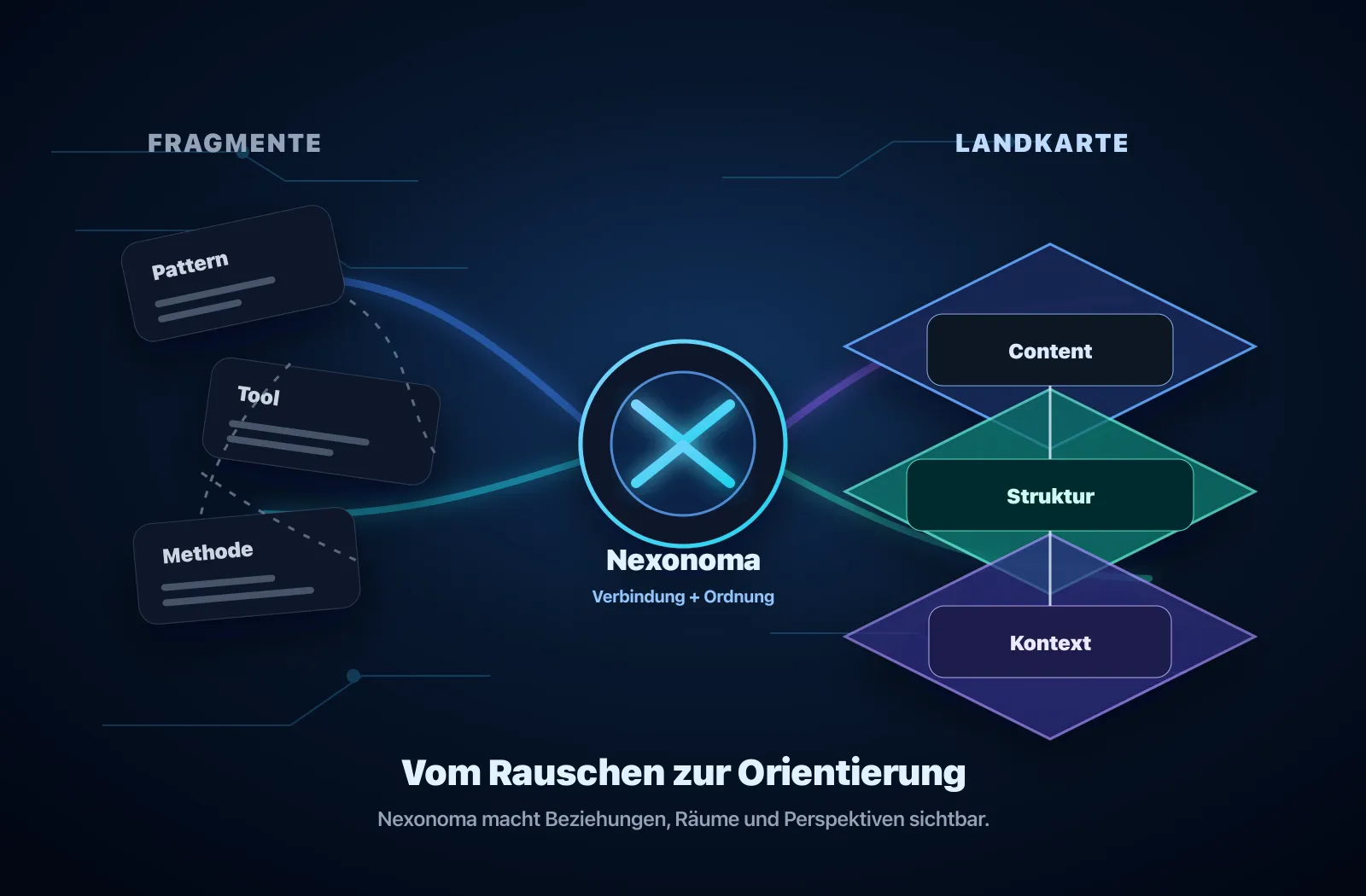
In practice, I kept seeing the same pattern: knowledge exists—yet fragmented. Each method, each pattern, each tool stands on its own, and only a few see the bigger picture.
That leads to decisions that feel uncertain. Not because people decide wrong—but because they lack the system that connects everything.
What you won’t find here
Nexonoma is not a link collection, not a pattern catalog, and not a document dump. You won’t find endless framework lists, best-practice collections without context, or isolated buzzwords.
Focus: understanding systems, not information overload.
What defines Nexonoma
Make connections visible
Architecture isn’t made of individual blocks—it’s made of relationships. We show the lines between the points.
Think systemically
Nexonoma understands architecture as a living system with feedback and dynamics—not as a static plan.
Understanding over overload
Not knowing everything—but recognizing what matters in context. We filter out the noise.
/ˌnɛksoˈnoːma/ • noun
Nexonoma
Connection, entanglement, node.
Law, order, structure.
"A knowledge network with clear order."
How Nexonoma is structured
Behind Nexonoma is a clear model. The system grows with every insight—step by step and always grounded in practice.
- 1Knowledge model Concepts, methods, technologies, and tools follow a consistent schema.
- 2Visual navigation Grid, matrix, and “city” layouts reveal relationships at a glance.
- 3Modularity Content can grow without overloading the system.
- 4Future AI models & graph analytics for automatic relationship discovery.
Nexonoma is created by Michael Meierhoff. Learn more about his architecture work at Meierhoff Systems.